
Mission Update:
Engineering the frontier.
SpaceFactory builds machines that extend human capability at the strategic frontiers of space, defense, and remote industry. From the lunar surface to the flightline, our robotic systems are designed to operate in austere environments with limited power, communications, and physical infrastructure.
We develop low-SWaP systems defined by rugged autonomy, GPS-denied navigation, and machine perception. Spanning autonomous mobility, logistics, and robotic construction, our technologies extend the reach and endurance of human activity.
We build and sustain the high ground—the sovereign foundation upon which exploration, defense, and industrial operations can expand and endure.
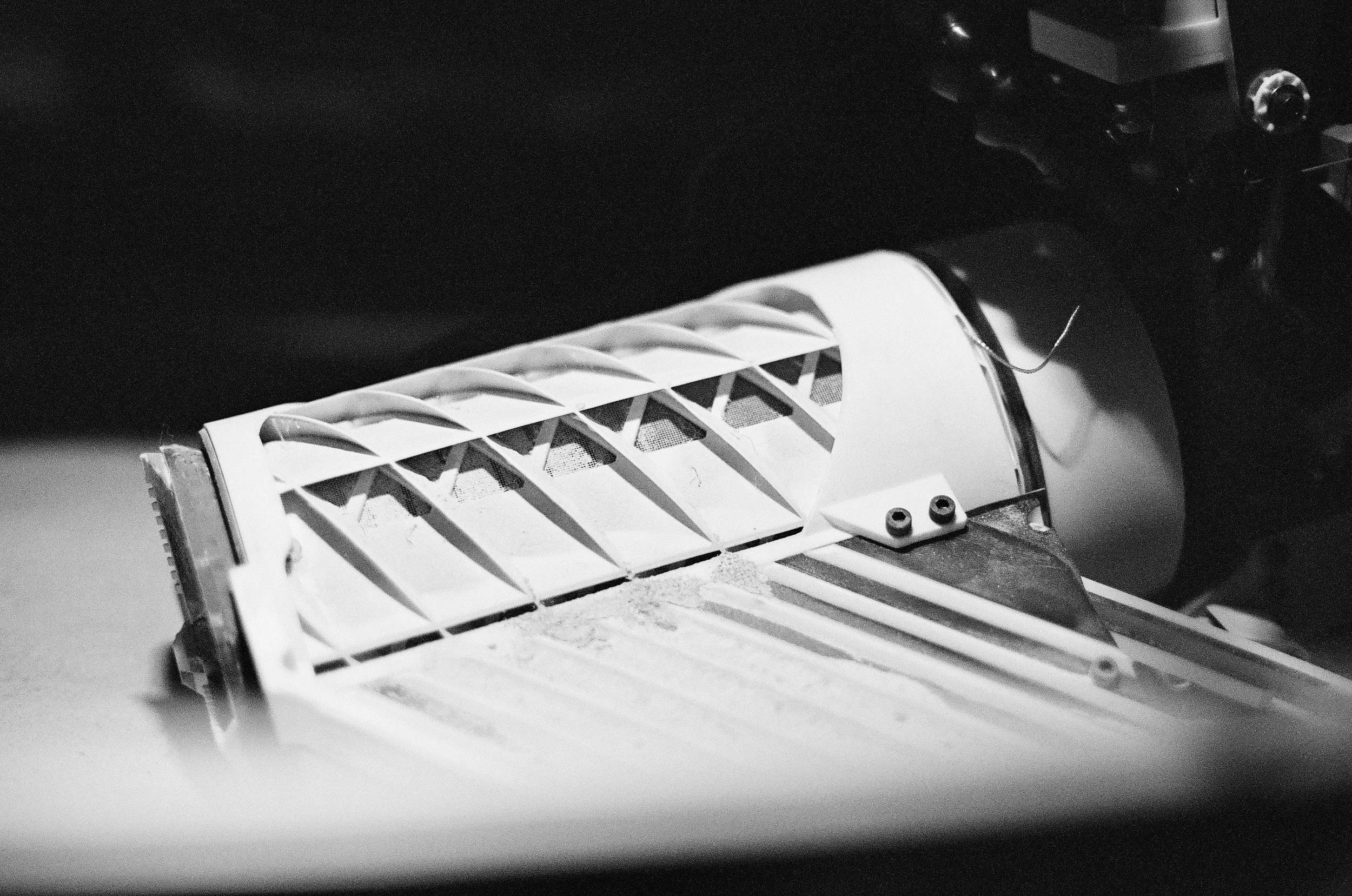
LITHOS-1 Lunar Payload
Turning Lunar Dust into Infrastructure
Sustained lunar surface operations depend on infrastructure that does not yet exist. Without stabilized surfaces, dust, plume effects, and terrain instability degrade equipment, limit mobility, and introduce mission risk.
LITHOS-1 is a near-term technology demonstration payload designed to improve access to and usability of the lunar surface by converting loose regolith into stable, load-bearing, reduced-dust surfaces.
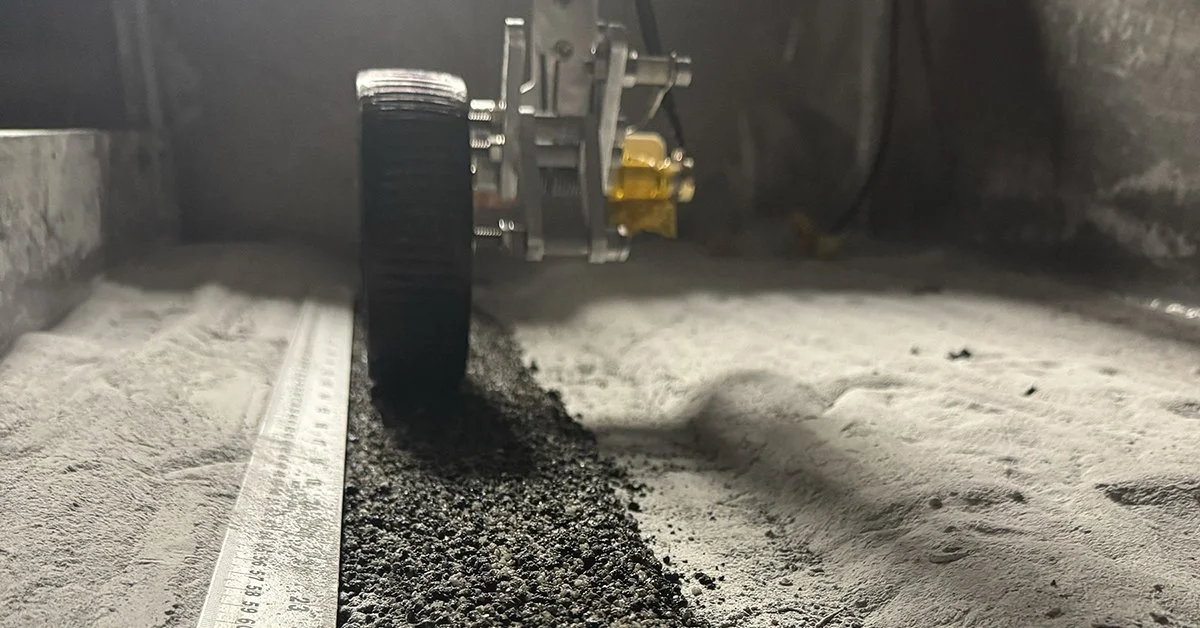
Lunar Inroads
Sustained lunar operations depend on reliable surface mobility and resupply missions. Unprepared regolith leads to wheel sinkage, dust generation, and inconsistent traversal, limiting range and increasing mission risk.
Stabilized, well-delineated tracks enable repeated traversals while reducing perception and compute requirements for autonomous rovers. In collaboration with Michigan Technological University, SpaceFactory demonstrated mobility along stabilized tracks under simulated lunar conditions, validating surface consolidation and dust-free mobility under repeated rover traversal.
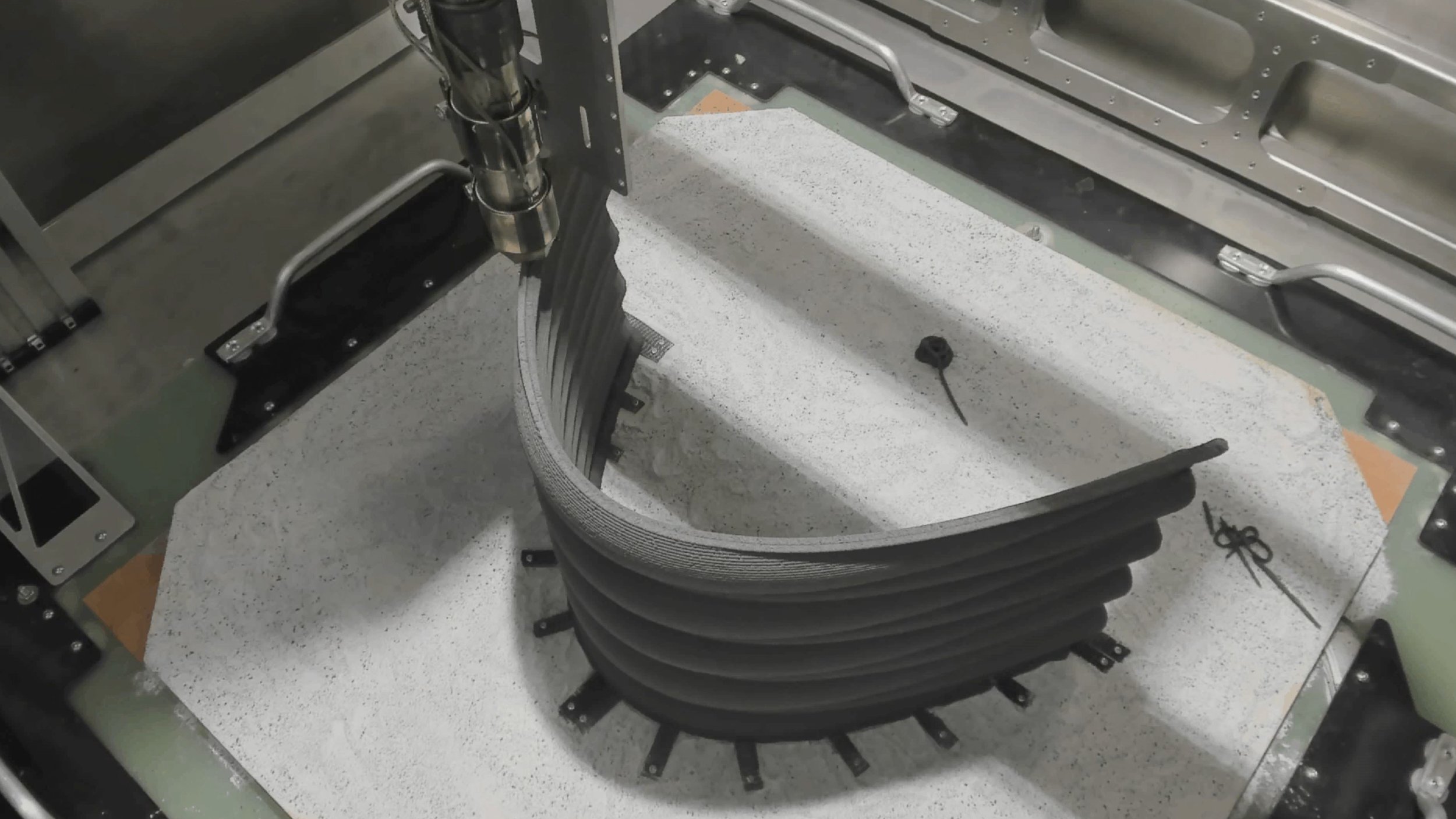
Lunar 3D Printing Milestone Achieved
In a historic first, SpaceFactory and NASA Kennedy Space Center partnered to perform the first-ever 3D printing in a freezing vacuum, emulating the harsh conditions found at the Moon’s south pole. This initiative successfully demonstrated 3D printing technology at the extreme temperature of -200°C using a lunar simulant and biopolymer matrix. The experiment validates the feasibility of constructing with lunar resources in such extreme environments, paving the way for future lunar habitats and infrastructure.
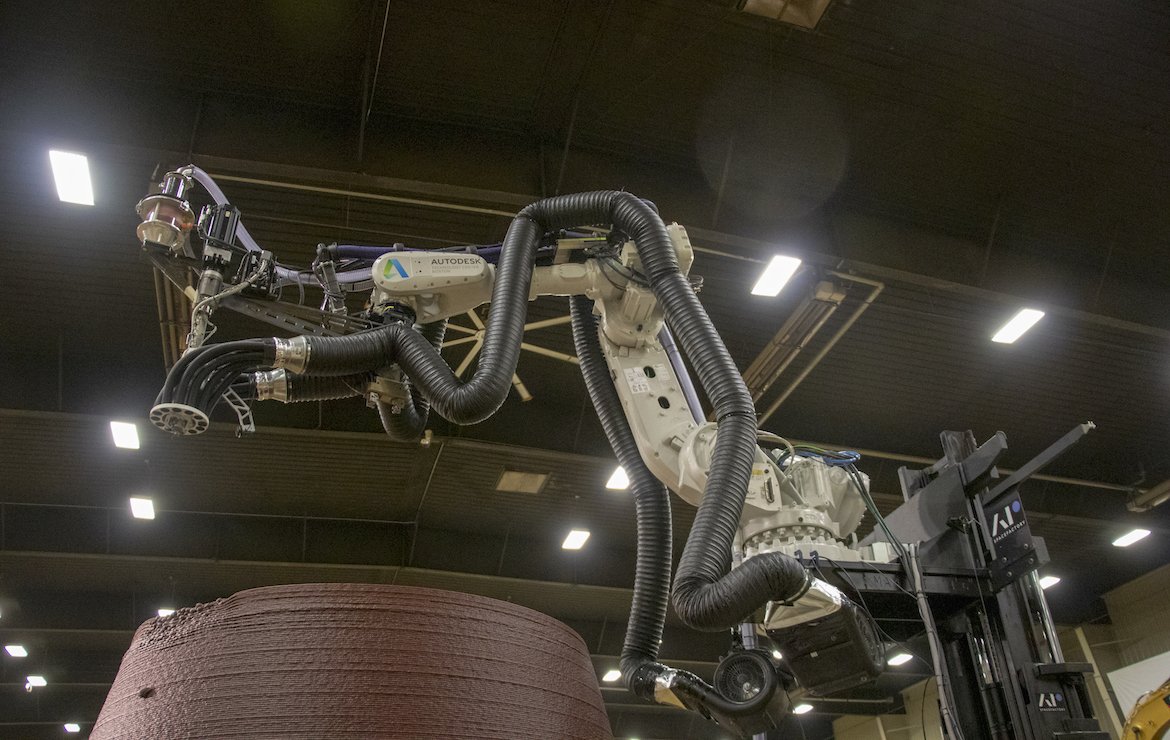
Reflecting on Our Roots: The NASA Centennial Challenge
SpaceFactory's journey began as a bold venture into the uncharted territories of large-scale additive manufacturing and extraplanetary construction with our groundbreaking project, 'MARSHA' (Mars Habitat). As a small startup, we dove head-first into the NASA Centennial Challenge, pioneering the use of a composite basalt-fiber and biopolymer to 3D print habitats designed for Mars. Winning this challenge was just the beginning.
-
Founded in 2016 by a interdisciplinary team of architects and engineers, SpaceFactory set out to pioneer the design and technologies needed to extend human capability at the frontiers of Earth and space, laying the foundation for exploration, security, and new economic opportunity.
-
SpaceFactory entered NASA's 3D Printed Habitat Challenge in its third and final phase which required the design and construction of a prototype Martian habitat. Through the challenge, we began to push the thresholds of what's possible within 3D printing technology and materials.
NASA CENTENNIAL CHALLENGE - DESIGN PHASE 2ND PLACE WINNER
SpaceFactory was one of five designs selected from a field of seventeen teams due to our innovative design born from the Martian environment. Our Mars habitat, MARSHA, marks a radical departure from previous habitat designs. MARSHA stands upright and tall on the Martian surface with highly human-centric, habitable spaces tuned to the demands of a Mars mission.
NASA CENTENNIAL CHALLENGE - 1ST PLACE WINNER
AI SpaceFactory was announced the ultimate winner of the NASA 3D Printed Habitat Challenge, receiving a $500K award to seed future research and development. Our 15-foot tall prototype was commended for its high degree of autonomy and use of a recyclable biopolymer 3D print material that withstood NASA’s pressure, smoke, and impact tests better than its concrete competitors.
-
AI SpaceFactory began the TERA (short for Terrestrial Analog) project to validate our space-technologies on Earth. An eco-friendly 3D printed dwelling made entirely with sustainable materials, TERA proves that revolutions in technology, artificial intelligence, and robotics can reduce waste and our collective carbon footprint through Space-driven construction.
-
SpaceFactory was one of 17 companies selected by NASA to co-develop lunar technologies under the Announcement of Collaboration Opportunity (ACO) program alongside Blue Origin and SpaceX.
The partnership between SpaceFactory and NASA Kennedy Space Center’s “Swampworks” successfully advanced lunar 3D print technology through testing in a vacuum chamber at temperature as low as -200°C using a regolith-polymer feedstock which could be produced locally on the Moon.
By 3D printing in a lunar-like environment, SpaceFactory and NASA made significant strides in maturing our technology for a possible lunar surface demonstration within the decade. -
In January 2023, SpaceFactory launched our pilot robotic arm 3D printer, ASTRA. Building on the prototype developed for the NASA Centennial Challenge, SpaceFactory engineered ASTRA for scale, simplicity, and sustainability. ASTRA’s mission is to enable the next generation of builders and creators through its use of recycled 3D print materials, automated tool-path algorithms, and user-friendly interface.
Starting September 2023, SpaceFactory will launch a series of large format gantry-style 3D printers which leverage technology developed through our NASA partnership. Beginning with the T200 “Starforge”, these modular printers are designed to help a wide spectrum of industries in producing intricate parts, streamlining operations, and unlocking unparalleled efficiencies in their processes. -
In partnership with Michigan Technological University (MTU), SpaceFactory set out to explore not only methods of building with bulk regolith, but developing novel materials and robotic systems to perform construction activities.
Unlike regolith-polymer composite 3D printing, these mass regolith infrastructures (MRIs) contain only 0.5-2.0% non-regolith mass yet can achieve over 150-times the strength of unstructured regolith. Through low-energy, low-mass applications, our research into MRIs is grounded in near-term, essential surface enhancements to support lunar launch-land, mobility, power, and communication systems.
In a short span of nine months, SpaceFactory developed several patent-pending technologies around building MRIs including constructing the first-ever lunar “road” in vacuum.
-
SpaceFactory launched development of a rugged, GPS-denied autonomous vehicle under a U.S. Air Force AFWERX SBIR Direct-to-Phase II contract. Designed to transport tools and equipment across active flightlines, the system aims to improve maintainer efficiency and mission readiness.